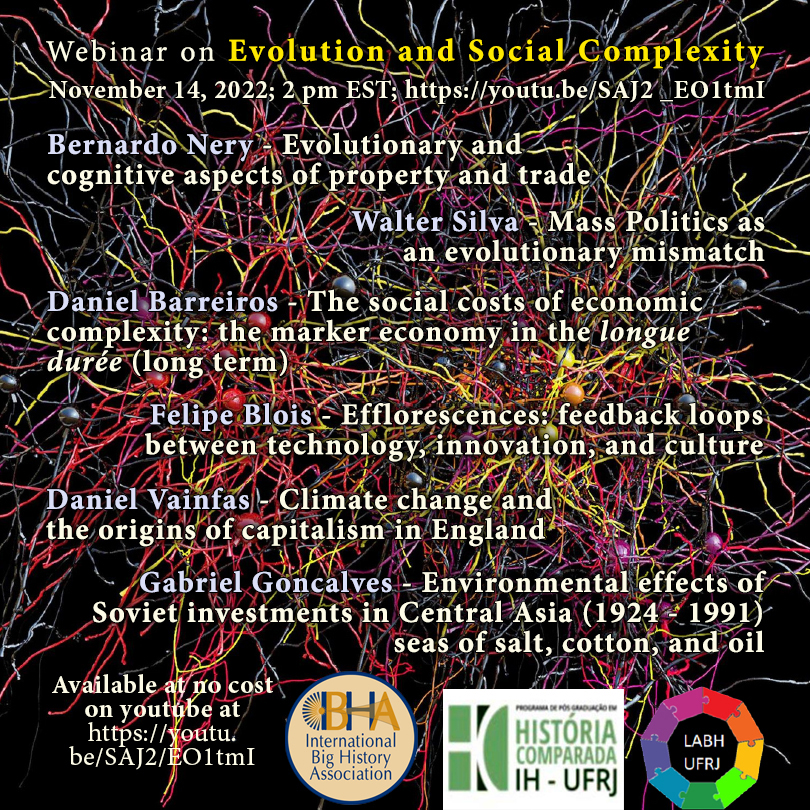
Evolution and Social Complexity
Please join us for a webinar on Evolution and Social Complexity on November 14 at 2 pm EST. To be live then at https://youtu.be/SAJ2_EO1tmI Organized by the Universidade Federal do Rio de Janeiro
Free

Please join us for a webinar on Evolution and Social Complexity on November 14 at 2 pm EST. To be live then at https://youtu.be/SAJ2_EO1tmI Organized by the Universidade Federal do Rio de Janeiro
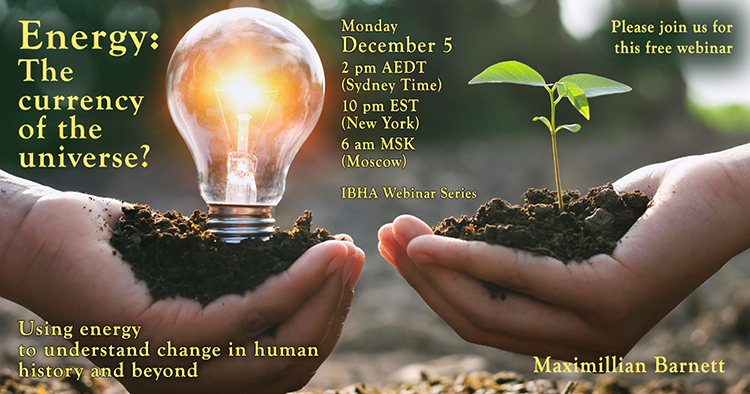
Energy flows have been central to the epic of evolution and big history for many years. In this presentation, Maximillian Barnett examines them in light of new research. He is a PhD Student working under Professor David Christian in the Department of History and Archaeology at Macquarie University, Sydney, Australia. Maximillian is a member of the International Big History Association and is part of a global research group which focuses on how understandings of the past can be used to inform approaches to present and future global challenges. He has recently presented papers entitled: “Breaking the Cycle: Alternative Complexity Outcomes for Human Societies” and “The Weights and Measures of World History.” He currently teaches and aids in curriculum development in the fields of law and world history. He graduated with a Masters of Research in History and writes on the fields of demography, geography, anthropology, world history, and futures studies. The current working title for his PhD is The Fork in the Road: Mapping Alternative Responses of Human Societies to the Threat of Collapse.
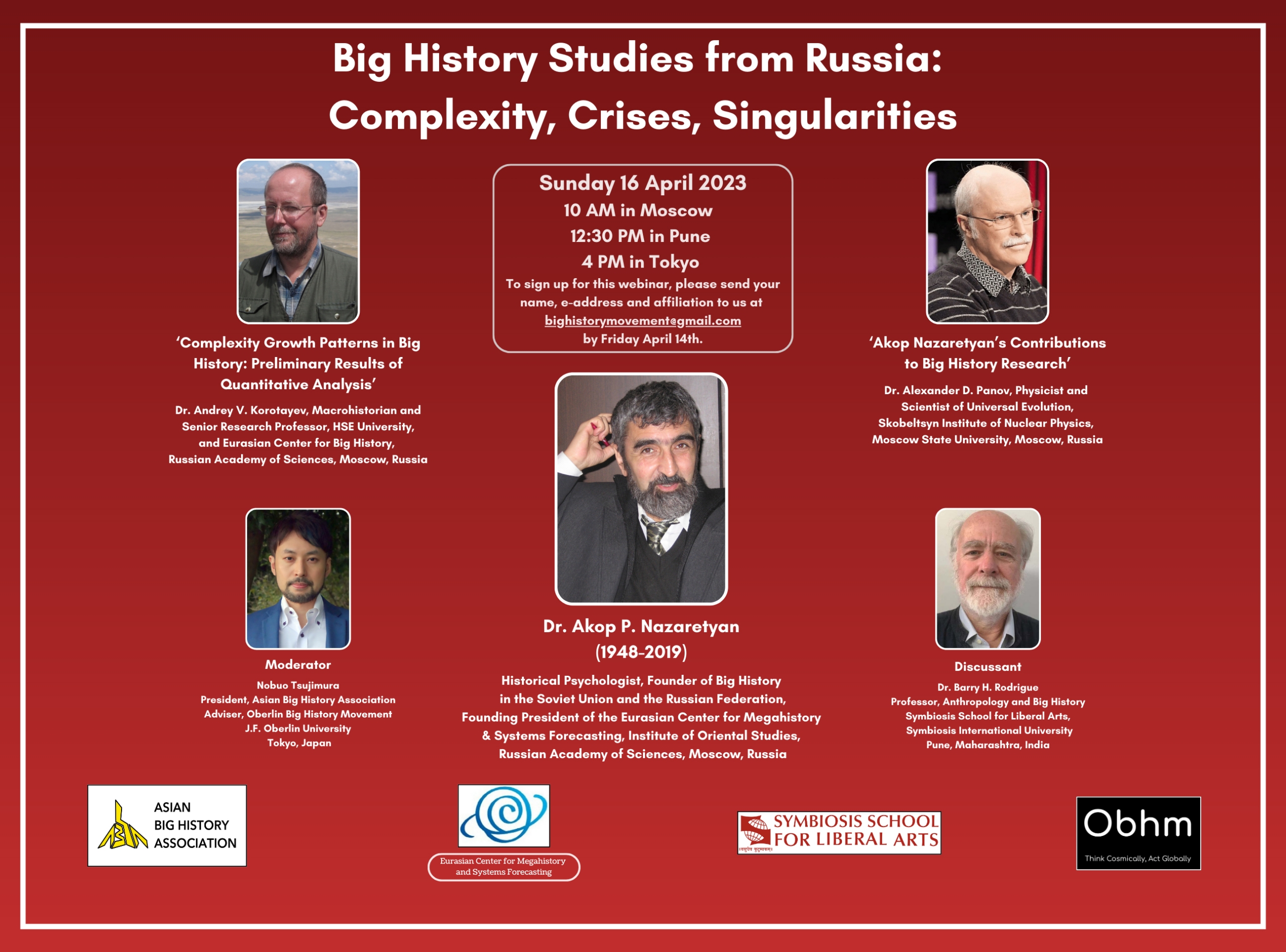
Contact bighistorymovement@gmail.com for registration
Please contact bighistorymovement@gmail.com for registration.
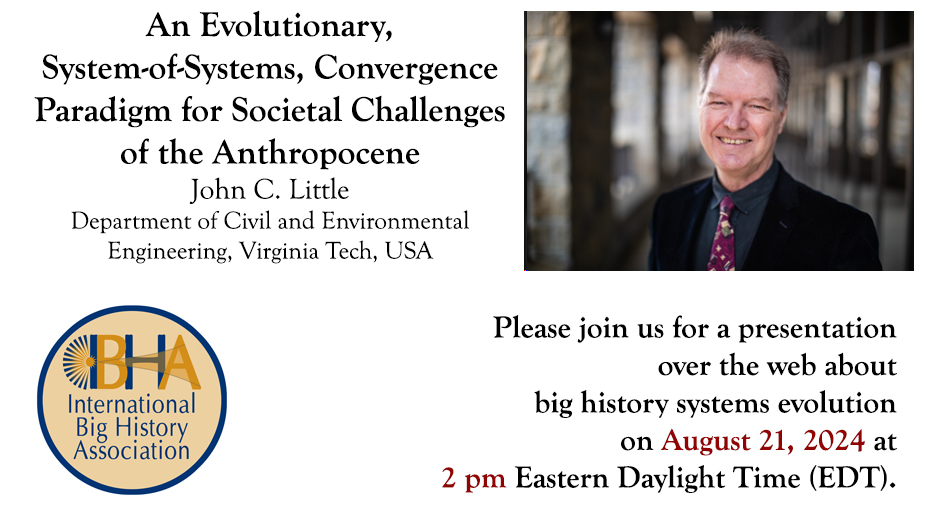
Abstract: Evolutionary mechanisms enabled humans to irreversibly transform Earth systems, culminating in the present-day, globally connected, system of Anthropocene systems. Because Anthropocene systems are highly interdependent and dynamically evolving, often with accelerating rates of cultural [...]
Iron is at the heart of so much big history. Massive stars fuse hydrogen and helium into heavier elements, until they begin to form iron, at which point a supernova explodes. Along with all the [...]