Iron is at the heart of so much big history. Massive stars fuse hydrogen and helium into heavier elements, until they begin to form iron, at which point a supernova explodes. Along with all the other elements, iron is burst out into space, where, in our case, it was added to the accretions that formed Earth. Much of it sunk deep into the Earth, providing a magnetic shield that protects us from solar winds. Some of it rusted into beautiful bands of rock that can be enjoyed in many geological sites like the US Painted Desert. It is crucial in how our blood transmits oxygen throughout the body. It has been central to the building of skyscrapers, bridges, and much more.
This webinar will discuss our experience designing and teaching a Big History of Iron course listed across four disciplines: History, Biology, Anthropology, and Geology, and taught in four coordinated sections at Jacksonville State University, in Alabama, USA. We will begin by outlining the administrative and institutional groundwork required to create and approve a genuinely cross disciplinary course, including coordination across departments and course listing within the university. We will then turn to the practical execution of the course itself, discussing course structure, shared themes, coordination among instructors, relevant local sites we visited as a class, and what worked, as well as what we learned, in teaching Big History collaboratively across the natural sciences, social sciences, and humanities.
Presented by:
Dr. Helen Kaibara-History
Dr. Jimmy Triplett-Biology
Dr. Kathryn Catlin-Anthropology
Dr. Ross Martin-Geology
Zoom link forthcoming
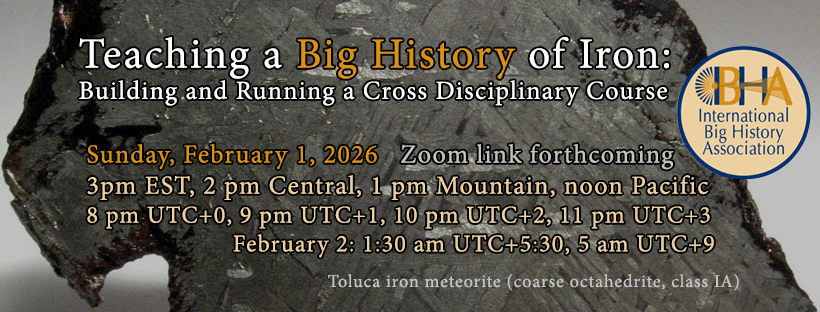
The image is of a Toluca iron meteorite (coarse octahedrite, class IA). Toluca is a group of iron meteorites found in Jiquipilco, Mexico near Toluca. The meteorites probably crashed into Earth more than 10,000 years ago. For centuries, Mexican people living near the meteorites used them as a source of metal for various tools. They were first described by conquistadores in about 1776. The total known mass is about 3 tons. https://en.wikipedia.org/wiki/Toluca_(meteorite)

This event has passed.